COMPLETE BEGINNER GUIDE
How to Budget Your Money in the UK (Beginner Guide)
Step 1 of 3 — Budgeting
Take control of your money
A simple beginner’s guide to budgeting, tracking spending, and saving more each month.
Start here
- Work out what’s coming in each month
- Understand where your money currently goes
- Build a simple plan you can realistically stick to
- Review and improve your budget over time
Who this guide is for
This guide is for you if:
- your money feels disorganised
- you keep overspending without noticing
- budgeting has felt overwhelming before
- you want a simpler system that actually works in real life
Table of contents
- Quick summary
- What budgeting is (and why it matters)
- What a good budget actually looks like
- Step 1 — Know your income
- Step 2 — List your expenses
- Step 3 — Categorise your spending
- Step 4: Choose a Budgeting Method (50/30/20, Zero-Based & Envelope)
- Step 5 — Track and review
- Example UK budgets
- Common mistakes
- How to adapt your budget
- Tools to help
- How long does it take to get your budget right?
- Common questions
- Next steps
What budgeting is
Budgeting doesn’t have to mean cutting back. It’s simply the process of planning how you use your money each month.
Everyone should have some kind of budget, no matter how much they earn.
At its core, it means:
- knowing how much money you have coming in
- deciding where it should go
A good budget helps you:
- avoid overspending
- reduce financial stress
- save more consistently
- feel in control of your finances
👉 Budgeting doesn’t have to be about restricting yourself — you’re giving your money a plan.
Quick Summary
- A budget is just a plan for your money
- It should reflect real life — not perfection
- Start simple and improve over time
- Want to see how the 50/30/20 rule works with your income? Try the free 50/30/20 budget planner.
Ready to build your own budget?
Download the free BetterWithCash Budget Planner and start organising your money in under 10 minutes.
Why budgeting matters
With the price of everything going up, it’s more important than ever to know what’s going on with your money.
Confronting your spending habits might be daunting, but you need to stay on top of your finances.
Budgeting helps you identify where your money goes. If done consistently, you’ll identify patterns and find potential issues before they become a problem.
No more getting caught short, or relying on overdrafts and credit cards. Make a budget and give every pound a purpose.
A budget helps you:
- understand your habits
- plan for essentials
- adjust when things change
- build savings over time
Once your budget is working, you’ll start to notice something important:
you’ll have leftover money with a purpose. That’s where the next steps come in:
- build an emergency fund
- start saving consistently
- begin investing for the long term
Want more background? Read the guide to budgeting for beginners →
What a good budget actually looks like
A good budget doesn’t need to be complicated.
At its core, it answers three simple questions:
- How much money is coming in?
- What are your essential expenses?
- How should the remaining money be used?
Basically, as things stand, are you living within your means or surviving on overdrafts and credit cards.
Most budgets include categories like:
- housing (rent, mortgage, council tax)
- food and groceries
- transport
- bills and subscriptions
- savings
- discretionary spending
The goal isn’t to make a perfect budget — it’s about awareness and control.
👉When you’re aware of your spending habits, you can cut out careless money mistakes and set realistic goals. Without goals, a budget has no purpose.
What if you have debt?
If you have high-interest debt, your budget should help you create small but consistent progress each month.
Focus on:
- staying current on essentials
- avoiding new debt
- building a small emergency buffer
- making regular repayments
A good budget gives your money direction — not punishment.
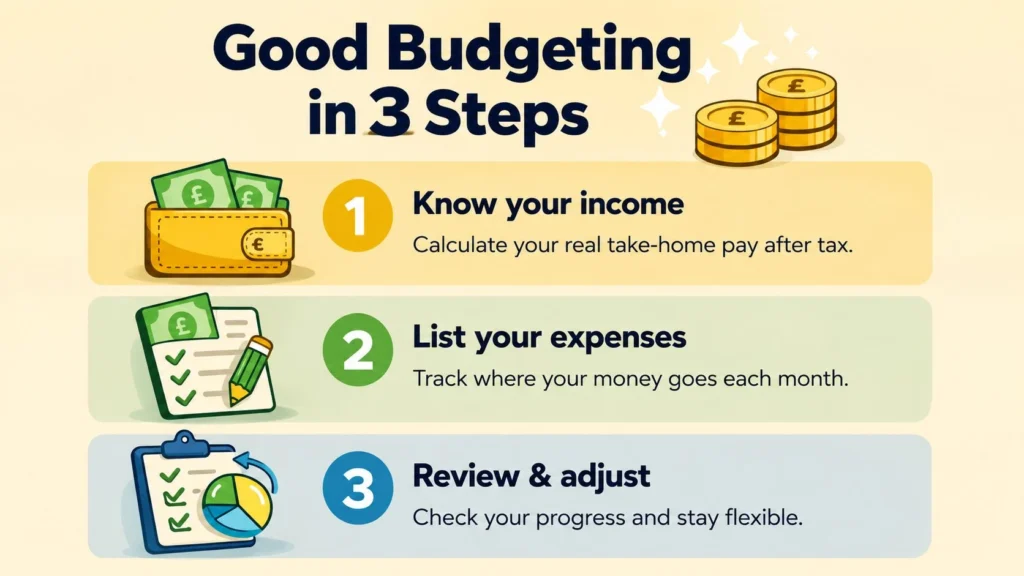
1
Know Your Income
Use your actual take-home pay (after tax and national insurance), not your salary before deductions. If your income changes each month, start with your lowest reliable monthly income — not your best month.
Build your budget around essentials first, then treat extra income as flexible money for savings, debt, or future goals. This helps you avoid overspending during higher-income months.
Include:
- salary
- other money that comes in – include any benefits, tax credits, saving or investment income
- regular receipts – things like rental income and pensions payments
👉 Right now: open your notes app and write down your monthly income. That’s step 1.
2
List Your Expenses
This is the most important and time consuming part. Try to be as accurate (& honest) as possible.
The more you list down, the better. Ideally, look at your spending for the last few months to get a true picture of your spending.
Start with your bank app or online banking. If you can, download the spending data so it’s easy to organise.
If you spend a lof of cash, try to find some of the receipts and add the expenses to your list. If you put a lot of purchases on a credit card you should look through the statements and add that too, rather than just including ‘credit card’ as one expense line.
If you miss things, that’s normal – a good budget will take time – just add new items later.
👉 Right now: go through your bank app and list of everything you spent money on last month.
Needs
Rent or mortgage, council tax, energy bills, food, transport, minimum debt payments
Wants
Eating out, subscriptions, shopping, entertainment
Don’t forget irregular expenses
Some expenses don’t happen every month – but they still count.
Things like:
- car insurance
- birthdays
- Christmas
- car repairs / MOT
- annual subscriptions
- home repairs
- school costs
can quietly destroy a budget if you only plan month-to-month
A simple fix is a “sinking fund”, which simply involves setting aside a small amount each month so bigger bills don’t become emergencies later.
Before building a budget, spend a week tracking your spending so you know where your money is actually going.
3
Categorise Your Spending
Group your expenses into simple categories:
- Essentials (housing, utilities, food, transport)
- Lifestyle (eating out, shopping, Netflix, gym membership)
- Savings
- Debt repayments (do you pay the minimum or the full balance?)
At this stage, try to break spending down into needs vs wants. Is it something you can’t live without or something you don’t want to live without?
Regular loan or credit card payments are another category of spending, as are any standing orders, e.g. transfers to investment or savings account.
This helps you see:
- where your money is going
- what you might want (or need) to adjust
👉 Quick check: which category is bigger than you expected?
4
Choose a Budgeting Method
Now decide how you want to manage your money.
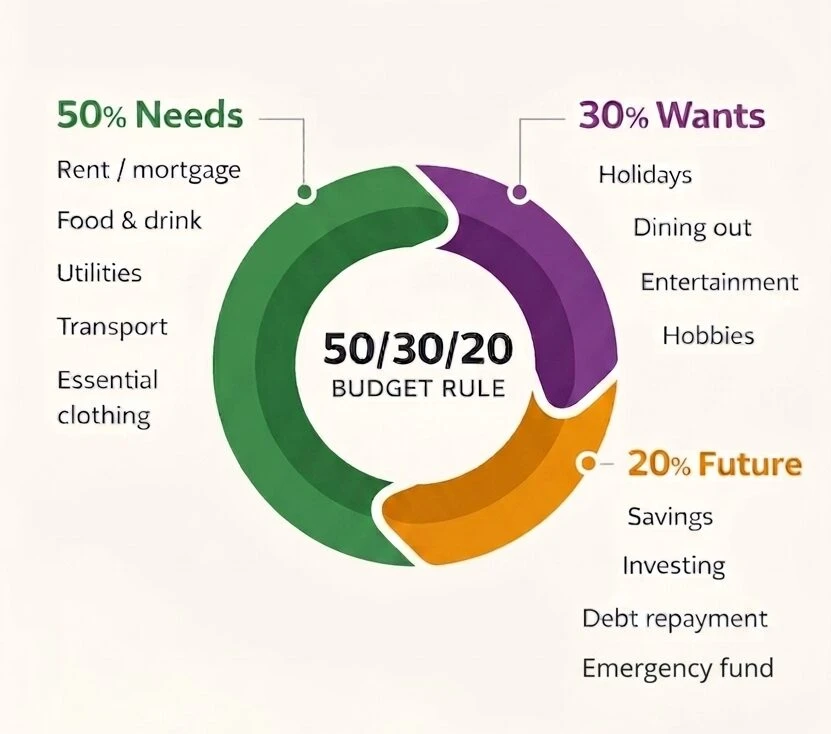
50/30/20
Best for beginners who want a simple starting point without having to track every pound. It even carves out a pot for indulgent spending.
Other options:
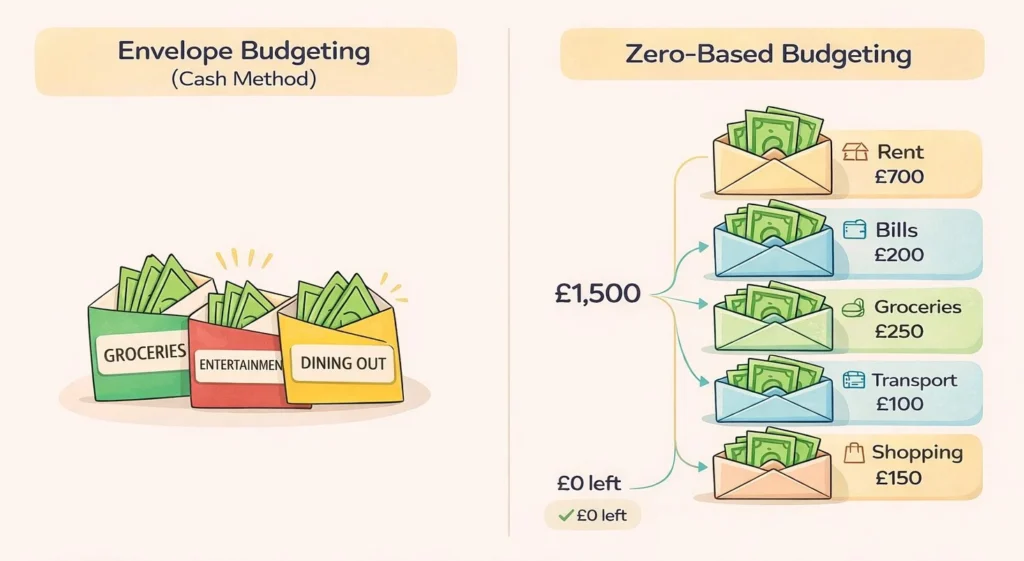
- Zero-based budgeting (more control)
- Envelope budgeting (fixed limits per category)
Zero-based budgeting
Better for people who want tighter control or those trying to stop overspending
👉 The best method is the one you’ll actually stick to.
Try the 50/30/20 budget planner
Use this simple planner to compare your spending with the 50/30/20 rule.
Needs (50%)
Essentials like rent, bills, food and transport.
£0 (0%)
Wants (30%)
Lifestyle spending like eating out, holidays, hobbies and shopping.
£0 (0%)
Future (20%)
Savings, investing, debt repayment and emergency fund money.
£0 (0%)
Total spending: £0
Money left: £0
Enter your numbers to see how your budget compares.
👉 Find out if 50/30/20 works for you. Or just get started with this free budget planner →
5
Track and Review
This is the step most people skip.
- weekly or monthly? It doesn’t really matter. Just pick a day to review your spending. When you’ve got the hang of it, it won’t take much work
- check what you actually spent
- compare it to your plan
- did one category go off-track? is it the same category every time?
- adjust next week rather than giving up
If you’re not sure where your money is leaking, start by tracking your spending for a week.
Make your budget easier with automation
The easier your system is, the more likely you are to stick with it.
Automating key parts of your money can help reduce stress and prevent missed payments.
You can automate things like:
- savings transfers
- bill payments
- debt repayments
- investment contributions
Even small automatic transfers build momentum over time.
👉 Your budget improves over time — it doesn’t need to be perfect from the start.
📈 Example UK budgets
Example: £2,000 take-home pay
- £1,000 essentials
- £600 lifestyle
- £400 savings
Example: £1,800 take-home pay
- £950 essentials
- £450 lifestyle
- £250 savings
- £150 buffer
Example: £2,500 take-home pay
- £1,250 essentials
- £650 lifestyle
- £450 savings
- £150 irregular costs
Example: £3,000 take-home pay
- £1,500 essentials
- £800 lifestyle
- £500 savings
- £200 irregular costs
👉 Use this as a starting point – your numbers don’t need to match exactly. Your budget should reflect your situation.
⚠️ Common mistakes
- Being too strict too quickly. Start looser than you think – you can tighten later.
- Forgetting irregular expenses. Add a small monthly buffer for things like birthdays and repairs.
- Trying to track everything in detail
- Not reviewing your budget
👉 Your budget should evolve, not stay fixed.
How to adapt your budget
Your budget will change – that’s normal. In fact, it’s a good sign, not a failure.
If your income changes
Budget from your lowest expected month and build a buffer.
If you overspend
Just make an adjustment the following week — don’t start again (& definitely don’t give up).
If you feel restricted
If it’s too complex, you’re more likely to give up. Simplify your categories and make it realistic over time.
If you’re paid weekly
Don’t get too granular. Work in weekly spending limits and a monthly bills pot.
Budgeting as a couple
If you share finances, start by agreeing on:
- shared essentials
- personal spending
- savings goals
- how bills will be split
Some couples combine everything. Others keep separate accounts and share costs.
The best system is the one both people can stick to consistently.
Free tools to help you take the next step
You do not need to build your whole budgeting system at once. Choose the tool that matches what you need help with next.
See where your money is actually going before deciding what needs to change.
Best for: building your budget from real spending rather than estimates.
Turn your income, bills and everyday spending into a monthly plan you can actually maintain.
Best for: creating a complete budget you can use month after month.
Use the 50/30/20 framework to see how your income is split between needs, wants and savings.
Best for: checking whether one broad area is taking too much of your income.
Get a personalised snapshot of what is working well and where your budgeting habits could improve.
Best for: identifying the one area most worth improving next.
⏱ How long does it take to get your budget right?
Most people don’t get their budget perfect in the first month.
It usually takes:
- 1–2 months to understand your spending
- 2–3 months to build consistency
- a few adjustments along the way
👉 Most people feel unsure at first – that’s completely normal.
Your budget should improve over time — not be perfect from the start.
Common questions
How much of my income should I save each month?
There’s no perfect number. A common starting point is 20% of take-home pay, but any amount is better than nothing. Start with what feels realistic and increase it over time.
What is the easiest budgeting method for beginners?
The 50/30/20 budget is often the simplest starting point because it focuses on broad spending categories rather than tracking every purchase.
Should I budget weekly or monthly?
Most bills are monthly, so a monthly budget usually works best. If you’re paid weekly, you can still use a monthly budget and give yourself weekly spending limits.
What if my income changes every month?
Budget using your lowest expected monthly income and treat anything extra as a bonus for savings, debt repayment or future goals.
How long does it take to get good at budgeting?
Most people need 1-3 months to understand their spending patterns and build a system that works consistently.
Do I need a budgeting app?
No. Many people successfully budget using a spreadsheet or simple planner. The best system is the one you’ll actually use.
What would you like to do next?
Choose the next step that’s most useful for you right now.
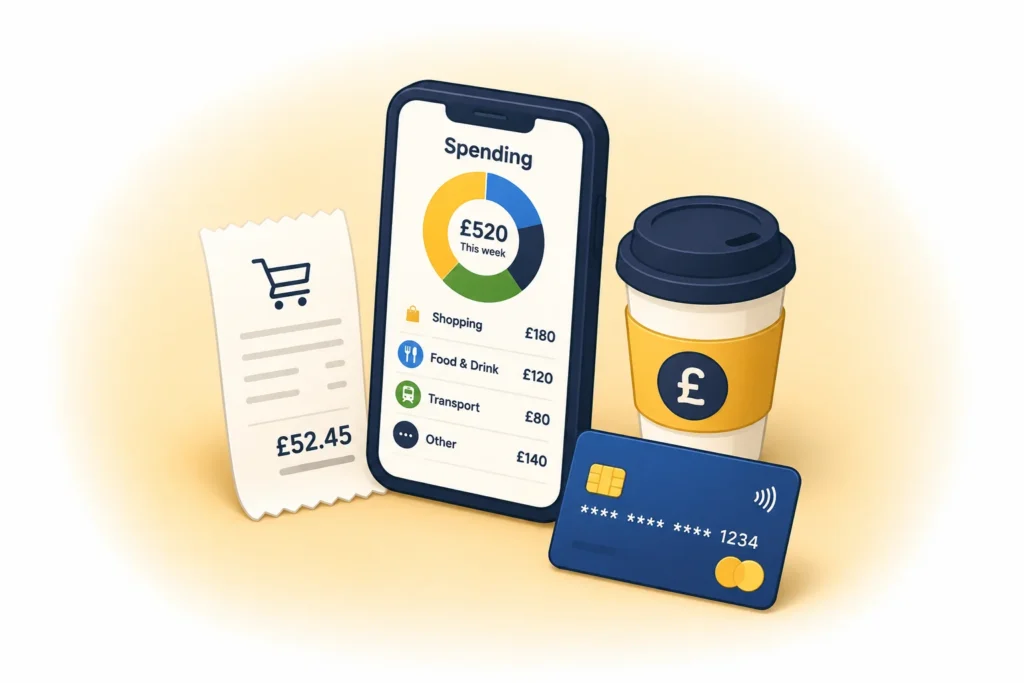
See where your money actually goes and use real spending patterns to improve your budget.
Learn how to control the spending habits that can knock even a good budget off course.
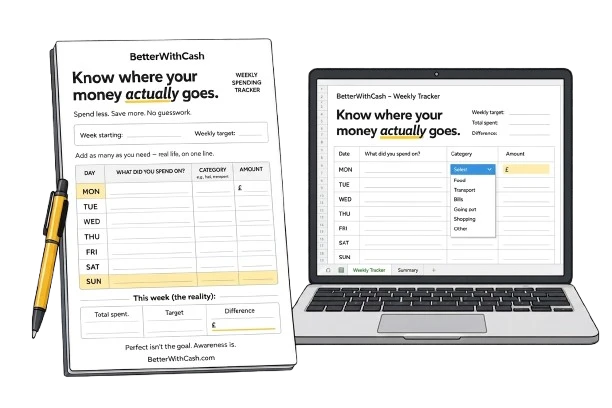
Build your first budget in 10 minutes
You’ve just learned the framework. Now use the planner to put it into practice.
- Takes under 5 minutes to setup
- Works with any income
- Helps you stay consistent