COMPLETE BEGINNER GUIDE
How to Track Your Spending (A Simple Beginner’s Guide)
Discover where your money really goes, uncover hidden spending habits and build a budget that actually works in real life.
Start here
- Track everything you spend for the next 7 days.
- Group purchases into a few simple categories.
- Look for patterns—not perfect accuracy.
- Adjust your budget using what actually happened.
Who this guide is for
If you’ve tried budgeting but it never sticks, or you’re not sure where your money is going each month, this guide will help you build a simple tracking habit that actually works.
Table of Contents

Quick Summary
- Tracking shows you where your money really goes
- You don’t need to track everything perfectly
- Tracking expenses helps you build a realistic budget.
- Start simple and stay consistent
Before choosing a tracking method, it’s worth understanding why tracking is one of the most powerful budgeting habits you can build. Once you see the benefits, keeping it up becomes much easier.
Why tracking matters
Most people don’t struggle because they can’t create a budget. They struggle because they don’t know where their money actually goes. It’s easy to underestimate everyday spending.
A few coffees here. A takeaway there. An impulsive Amazon order, or a subscription you forgot about. Individually, they don’t seem important, but together they can completely change your budget.
Tracking your spending replaces guesswork with facts. Instead of wondering why you’re always running out of money, you’ll be able to see exactly what’s happening—and decide what to change.
Think of your budget as a plan. Tracking is the feedback that tells you whether that plan is actually working.
Tracking helps you:
- Spot spending habits you didn’t notice.
- Find categories where you’re regularly overspending.
- Build a budget based on real life—not estimates.
- Feel more confident about your money decisions.
If you’re completely new to budgeting, start with our How to Budget Your Money guide to build your first budget, then come back here to learn how to keep it on track.
Why most people give up
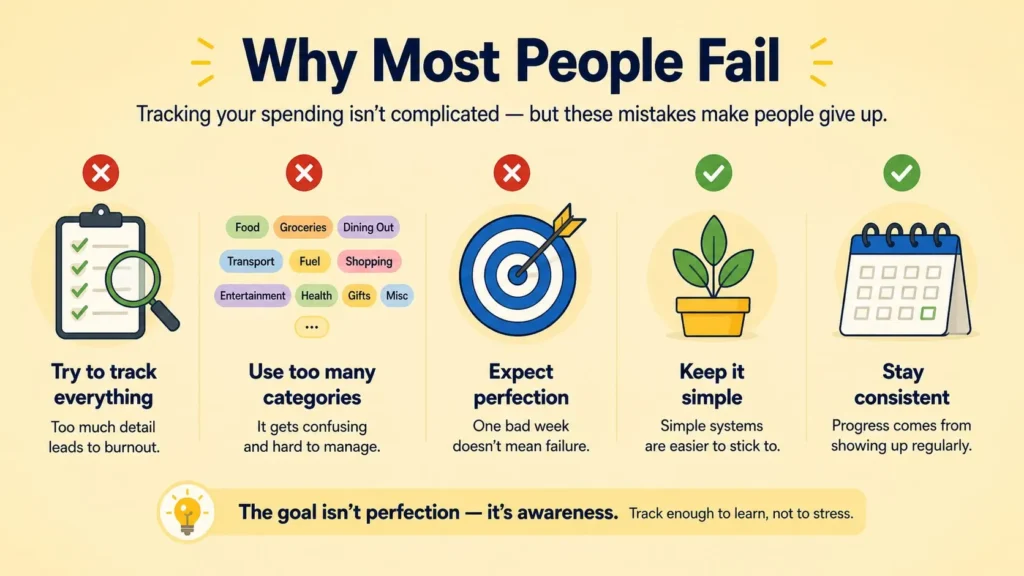
Tracking your spending isn’t difficult. The problem is that many people try to make it far more complicated than it needs to be.
They download a detailed spreadsheet. Create twenty different spending categories. Track every coffee. Miss one day. Then give up completely.
The goal isn’t to build the perfect spending record. The goal is to understand your habits well enough to make better decisions.
Most people stop tracking because they:
- Try to record every single detail
- Create too many spending categories
- Spend more time tracking than learning
- Expect perfection instead of progress
Instead:
- Keep categories broad.
- Review your spending regularly.
- Focus on consistency rather than accuracy.
If you can stick with a simple system for four weeks, you’ll learn far more than someone who spends two days building the perfect spreadsheet.
Find your tracking style
Not everyone tracks money the same way. Answer five quick questions to find a method that fits your habits, your patience and the amount of detail you want.
It takes less than a minute. No email or sign-up required.
Your recommended approach
The Simple Checker
You are most likely to stick with a quick weekly review rather than recording every purchase.
Start with:
- Reviewing your bank statement or banking app once a week.
- Looking for unusual purchases and changes in your balance.
- Checking only a few variable categories, such as food, transport and shopping.
Watch out for: relying only on your current balance. Always review the transactions behind it.
Your recommended approach
The Quick Note-Taker
You need a low-effort system that is always nearby. A Notes app or small notebook should give you enough awareness without becoming a chore.
Start with:
- Writing down variable purchases as you make them.
- Using only three to five broad categories.
- Adding everything up during a short weekly review.
Watch out for: trying to record too much detail. A short, consistent list is more useful than a perfect one you abandon.
Your recommended approach
The Spreadsheet Planner
You are likely to enjoy a structured system that groups purchases, calculates totals and makes spending patterns easy to compare.
Start with:
- Recording purchases in a simple spreadsheet.
- Reviewing category totals once a week.
- Comparing what you spent with what you planned.
Best BetterWithCash option: use the Budget Blueprint if you want tracking and budgeting brought together in one place.
Your recommended approach
The Automatic Tracker
You want useful detail without entering every transaction manually. A banking or budgeting app with automatic categorisation is likely to suit you best.
Start with:
- Choosing one reputable app rather than testing several at once.
- Checking automatically assigned categories for mistakes.
- Reviewing the dashboard once a week rather than watching it constantly.
Watch out for: assuming automatic categories are always accurate. The app gathers the information, but you still need to review it.
Your recommended tracking method
Your quiz result is a useful starting point, not a rule.
The best tracking method is the one that gives you enough information to make better decisions without becoming another chore.
Use the comparison below to see how the main options differ before choosing the approach that feels most realistic for you.
Compare spending-tracking methods
There is no single best way to track spending. Each method offers a different balance of speed, detail and effort.
| Method | Best for | Effort | Main advantage | Watch out for |
|---|---|---|---|---|
| Bank statement or banking app | People who want the quickest possible overview | Low | No separate system or manual data entry | Checking only your balance and ignoring individual transactions |
| Notes app or notebook | People who want a simple, hands-on habit | Low | Fast, flexible and easy to start | Forgetting to record purchases as you make them |
| Spreadsheet Most flexible | People who like categories, totals and clear comparisons | Medium | Easy to customise and useful for building a realistic budget | Creating an overly detailed system that becomes difficult to maintain |
| Automatic budgeting app | People who want detailed information with minimal input | Medium | Automatically gathers and categorises transactions | Incorrect categories, subscription costs and account-access permissions |
Choose the simplest approach that gives you enough information to notice patterns and make better decisions.
You can always start with a bank-statement review or Notes app, then move to a spreadsheet or automatic app if you want more detail later.
The important thing is not which method you choose. It is whether you review what you have tracked and use it to improve your budget.
1
Choose a Simple Method
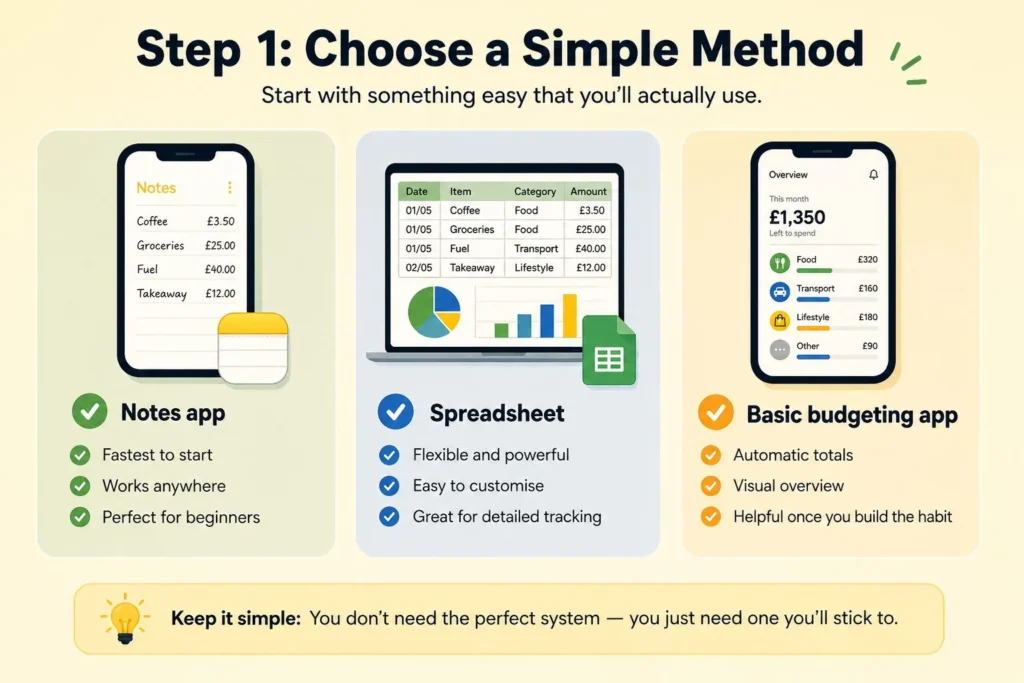
Now that you have compared the options, choose one method and use it for the next seven days.
Start with:
- your bank statement or banking app
- a Notes app or notebook
- a simple spreadsheet
- or an automatic budgeting app
Do not combine several systems at once. One simple method used consistently will teach you more than a complicated setup you abandon after a few days.
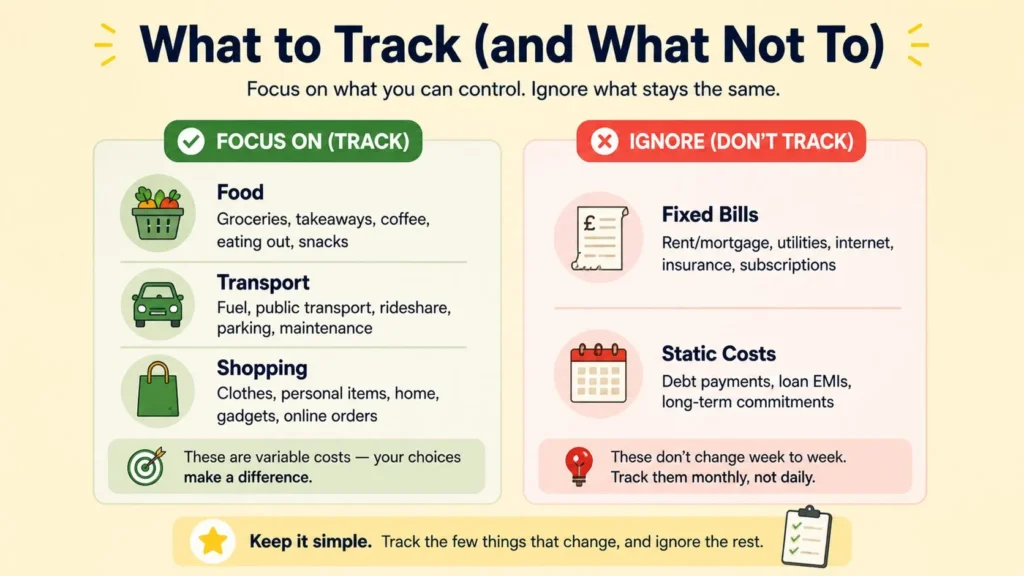
What to track (and what not to track)
Focus on
- everyday spending (food, transport, shopping)
- variable costs that change week to week
You don’t need to worry about:
- fixed bills (rent, subscriptions)
- anything that doesn’t change much
👉 The goal is to understand your habits — not build a perfect system
2
Track your Spending
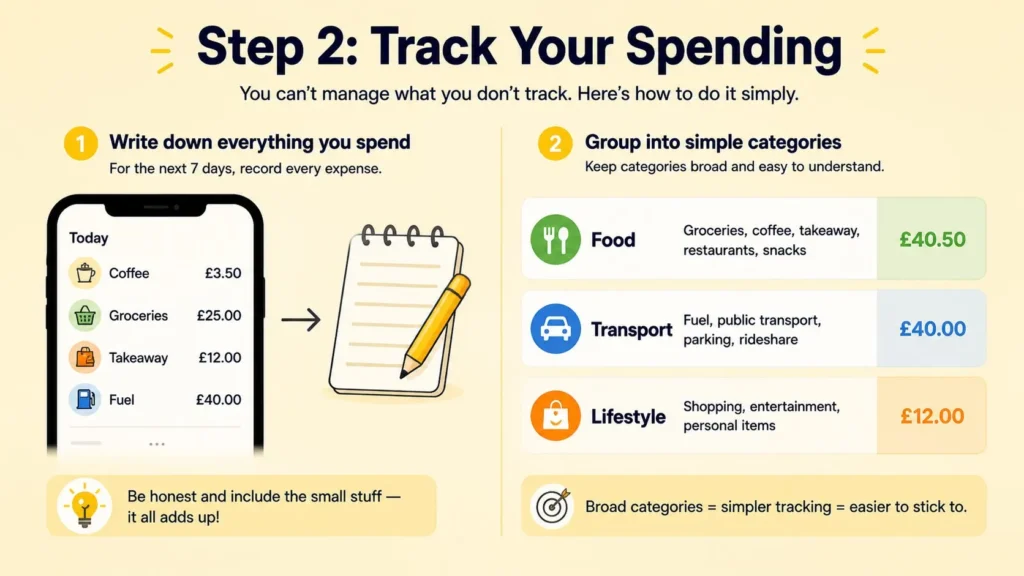
For the next seven days, record your everyday spending using the method you chose in Step 1.
You can enter purchases as they happen, or review them later using your bank statement or banking app.
A bank statement is often the easiest place to start because most card payments are already listed for you. Review the transactions, then group them into a few broad categories such as:
- Food
- Transport
- Shopping
- Lifestyle
Include small purchases as well as larger ones. A £3.50 coffee may not feel important on its own, but repeated purchases are often where useful patterns appear.
You do not need to create a perfect record. The aim is simply to understand where your flexible spending is going.
Examples:
- £3.50 coffee
- £25 groceries
- £12 takeaway
- £40 fuel
Using your bank statement?
Review at least one full week of transactions. Ignore transfers between your own accounts, but include cash withdrawals unless you already know what the cash was used for.
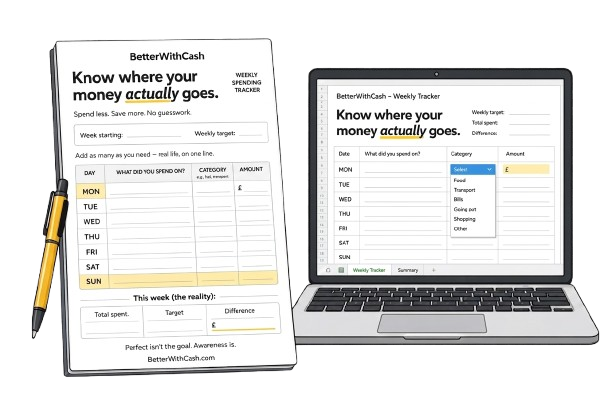
If you’d rather use a ready-made tracker, download the free Budget Planner.
3
Review and Adjust
At the end of each week:
- total each category
- compare to your budget
- if you’re not sure what your category targets should be, a 50/30/20 budget can be a useful starting point.
- identify where you overspent
Then adjust next week.
- food
- transport
- lifestyle
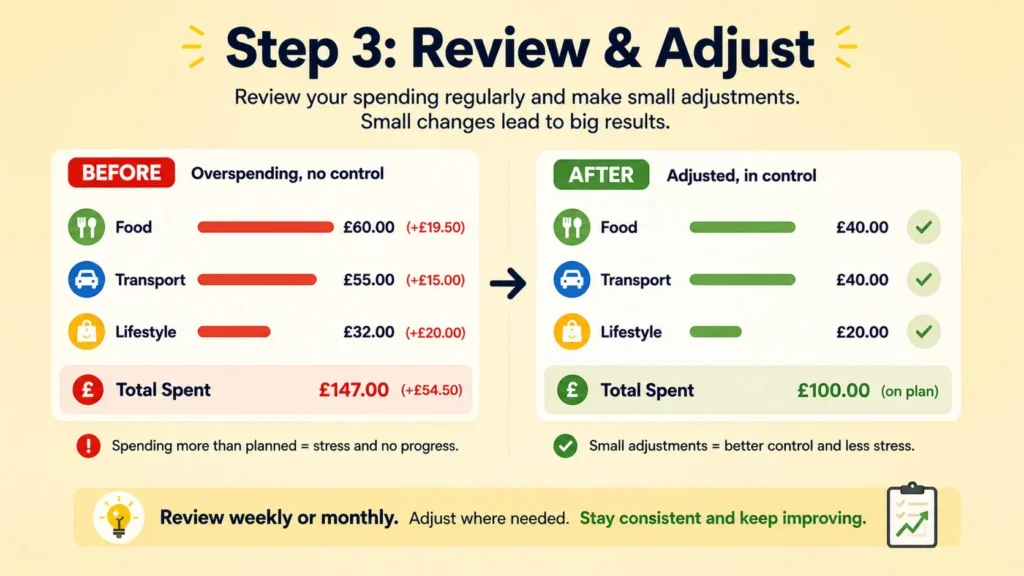
Tracking is only useful if you act on what it reveals. Answer three short questions to find your most useful next step.
Real life scenarios
🔎 If you feel like you overspend but do not know where
Tracking shows which categories are absorbing more money than expected.
📊 If your spending changes every week
Tracking helps you calculate a realistic average instead of budgeting around an unusually cheap or expensive week.
🎯 If you keep going over budget
Tracking helps you see whether the problem is your spending behaviour or an unrealistic budget target.
👉 This is why tracking matters: it replaces guesswork with clarity.
Should you review your spending weekly or monthly?
Both approaches work, but most beginners benefit from starting with a weekly review.
A weekly check helps you spot problems while there is still time to respond. Once tracking becomes familiar, you may prefer a single monthly review for a broader view of your spending.
Use the comparison below to choose the rhythm you are most likely to maintain.
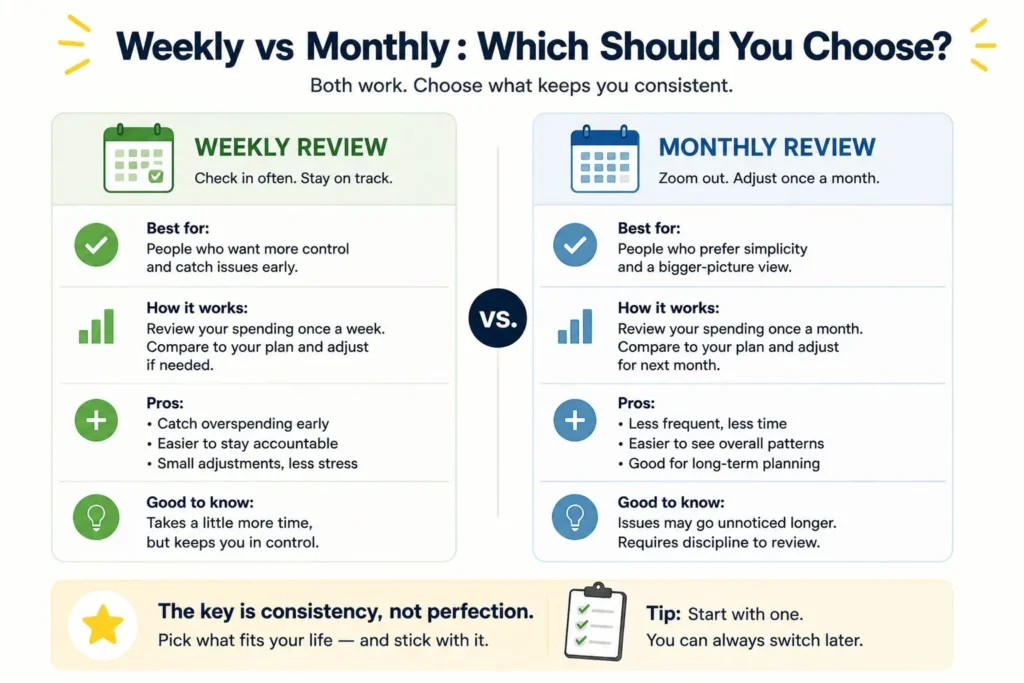
Start with weekly reviews. You can always move to monthly reviews once your spending feels more predictable.
⚠️ Common mistakes
- Tracking too many categories
- Giving up after one bad week
- Trying to be too precise
- Not reviewing your spending
👉 Consistency matters more than accuracy.
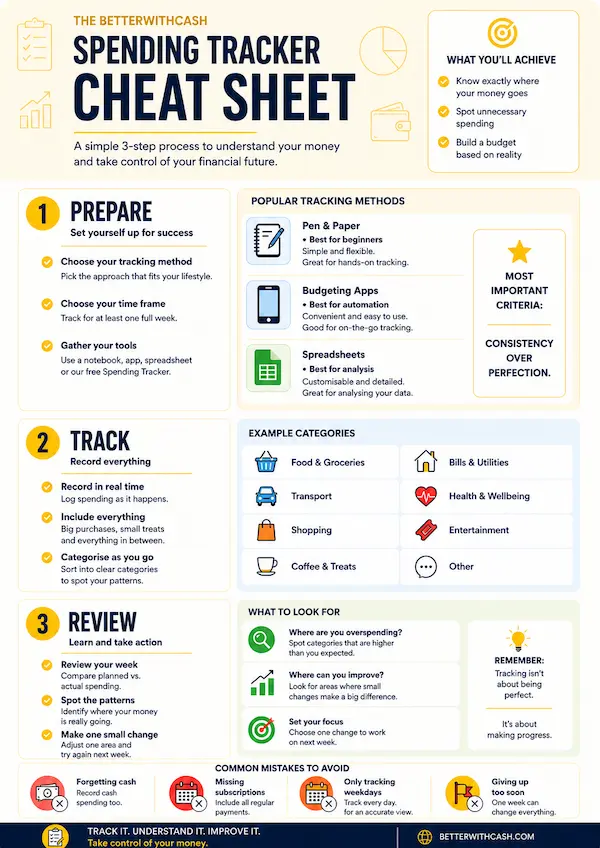
FREE ONE-PAGE CHEAT SHEET
Keep the Key Steps Handy
Download a printable one-page summary of the key steps, so you can quickly refresh what to track, how to track it and when to review your spending.
Free PDF · No sign-up required
Free tools to help you take the next step
You do not need to build your whole budgeting system at once. Choose the tool that matches what you need help with next.
Start with the Spending Tracker
Record purchases for a week and group them into simple categories so patterns become visible.
Best for: getting a clear manual record of where your money goes.
Use seven small daily actions to turn what you notice in your spending into practical changes.
Best for: moving from awareness to action without overhauling everything at once.
Discover the behaviours and triggers that tend to shape the way you spend.
Best for: understanding why you spend, not just where the money went.
Use what you have learned from tracking to create a monthly plan based on real life.
Best for: turning spending data into a budget you can actually maintain.
⏱ How long should you track your spending?
Start with seven days.
That is usually long enough to practise the habit and notice obvious patterns.
For a clearer picture:
- Track for 2–4 weeks to see how spending changes.
- Continue for 2–3 months if you are still building your budget or your spending varies significantly.
You may not need to record every purchase forever. Once you understand your normal spending, a short weekly or monthly review may be enough to keep your budget on track.
Common questions
How often should I track my spending?
Review your spending at least once a week. Weekly reviews make it easier to spot problems early and stay consistent.
Do I need to track every purchase?
No. The goal is awareness, not perfection. Focus on the spending categories that change regularly and influence your budget.
What categories should I use?
Most beginners only need a few broad categories, such as food, transport, shopping and lifestyle. Too many categories can make tracking harder to maintain.
Is it better to track spending weekly or monthly?
Weekly tracking is usually easier for beginners because feedback is faster and habits develop more quickly. Monthly reviews become more useful once tracking is already established.
Can I track spending using my bank statement?
Yes. Reviewing your bank statement is often the simplest way to start. Group transactions into broad categories and look for patterns rather than trying to create a perfect record.
What would you like to do next?
Choose the next step that’s most useful for you right now.

Turn Your Spending Into a Budget in 10 Minutes
You now know what to track, how to record it and when to review it. Use the free Budget Planner to turn what you have learned into a realistic monthly budget.
- What to track
- How to track it
- How often to review it